

The United States recently renamed Lake Ontario as Lake America. This follows a similar move to rename the Gulf of Mexico as the Gulf of America. The idea of renaming Lake Erie as Lake Pennsylvania has also been proposed.
The Gulf of Mexico is named after the Aztecs (who are the Mexica in the Nahuatl language), an Indigenous nation in existence long before America. Lake Ontario has been called Lake Ontario for centuries because it is a Wendat name meaning beautiful or sparkling water. And Erie, similarly an Indigenous name, used by the Erie people, described the lake as a cat tail. Erie, too, has borne its name since time immemorial. One must ask, Why do Indigenous names count for nothing? Should there not be a pause to think about what naming really means?
In the first chapter of the Gospel of Mark, verses 21 to 28, there is a scene in which Jesus is teaching in a synagogue. A man with an unclean spirit cries out to Jesus, “I know who you are.” In the scene, the unclean spirit is evidently afraid and wants to know what Jesus is up to. He yells out, “I know who you are” as if to warn, “the jig is up,” or something to the effect of, “don’t even try to fool me.” The attempt is to silence Jesus, to set him back on his heels, and to control his power. The unclean spirit confesses, “You are the son of the Most High,” and that alone should have been enough not to honor Jesus but to hold him in check. Afterall, flattery can get you everywhere.
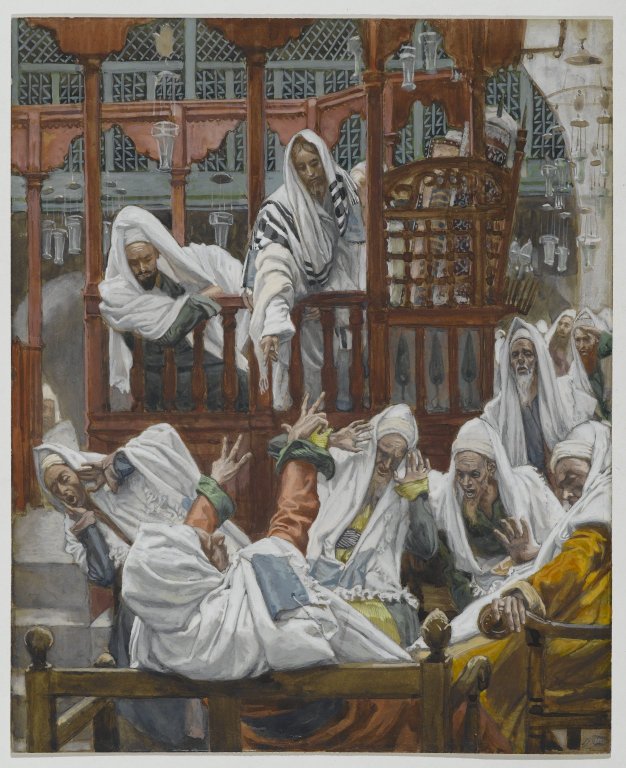
The response the unclean spirit receives from Jesus is unexpected, for Jesus tells him to shut up! Is Jesus tired of unclean spirits making stupid claims? It sounds like it, but we are only in the first chapter of Mark. There is a foreshadowing here. Unclean spirits do not stand a chance against Jesus. Even with great flattery, Jesus tells the unclean spirit to leave the body it possesses, and helplessly it leaves.
The dynamic of this story is interesting, and even though it unfolds in the ancient world where the idea of demon possession was common, it still speaks to us. In the Gospel of Luke, the spirit is referred to as an unclean demon, but both in Mark and in Luke’s retelling of Mark, the intention of the spirit is to use a name to control reality.
In antiquity, a name has power because it represents the breath of, or what we can call the essence or living power of, the thing named. Whether or not the etymology of the name actually matched the symbol, animals were frequently invoked for their powers. Ancient Egyptians associated cats and crocodiles with protection; to the Greeks, the eagle represented Zeus; to the Romans, a wolf symbolized strength and loyalty; and throughout the Mediterranean and beyond, the serpent was a symbol of healing.
A name is a symbol because the name represents the power of the thing named. Human beings are, or used to be, very particular about naming their children because the name not only captured the essence but also the nature and destiny of the child. Being named after an ancestor effectively recreates the ancestral power inside the child.
The demon in Mark and Luke wants to name Jesus because it wants to grasp the essence of Jesus and, in this sense, render Jesus subordinate. It does not work. Jesus sees through the malarkey, refuses to acknowledge the fallacious power grab, and understands that the demon is a show-off who lacks content. In other words, the demon’s act of naming is a misnaming or a misalignment of names, for the demon’s words do not properly represent the power involved in the encounter with Jesus. If anything, the words are empty, holding no power, so Jesus easily shakes them off by telling the demon to shut up.
People were compromised in antiquity, as much as today, when they honored false names and, thus, gave their souls over to false powers. A wisdom teacher like Jesus, and indeed like any wisdom teacher, rectified names, reset or realigned their essence, by restoring the proper sense of their power to their proper meaning in life. When we take naming seriously, we might note that the name human has, as its essence, humility, for the word human, as far as we can tell, is from the same Proto-Indo-European word for earth.
There is no etymological relationship between the words human and respect, but the evidence of being authentically human surfaces in the act of giving respect. Jesus offers no respect for the demon because it offered none to him. Instead, Jesus tells the demon to shut up and get out of here. The demon had feigned respect, but only a fool would accept what is false for what is true. Jesus was no fool.
We learn from this unique story in Mark that is copied by Luke to remember the association of a name with respect and to understand that honoring a name comes with responsibilities, particularly the responsibility of being authentically human.
When we decide to name things after our own pride, when we use names to disregard history and disrespect Indigenous nations, we are not honoring our humanity and obviously not caring for humility, let alone respect. We may, instead, be opening ourselves to the same reply Jesus gave to the unclean spirit in Mark 1:25.
The views expressed are the author's theological reflections and do not constitute endorsement of any political candidate or political party.
Get new scholarship, events, and blog posts delivered straight to your inbox.


Join the Conversation in the Westar Public Square
We’re updating how we engage with your thoughtful feedback! Blog post comments will no longer be hosted on our website. Instead, members can join the conversation in the Westar Public Square, where blog post links will be shared for deeper discussions.
Not a member yet? Join us to connect with a vibrant community exploring progressive religious scholarship! Become a Member Today