

Adam Smith (1723–1790) is touted as the original capitalist. He is revered as a free-market economist with an expressed faith in the invisible hand. But was he really a founding libertarian icon? Milton Friedman seemed to think so,1 but Smith only referred to the invisible hand once in his famous book, The Wealth of Nations. So, was Smith actually the epitome of laissez-faire capitalism? Let’s look closer.
Adam Smith lived when Deism was the reigning philosophy of the day. He was not religious, and he lived in a Newtonian world of natural laws. After Isaac Newton (1643–1727), religious revelation was no longer a source for scientific knowledge. Rather, nature provided all the evidence needed of the laws that govern it. In Deism, if there is a God, then God is the being who made the laws and gave the universe an originating push. After the universe was set in motion, perhaps God sustains its laws but otherwise has nothing further to do with it.
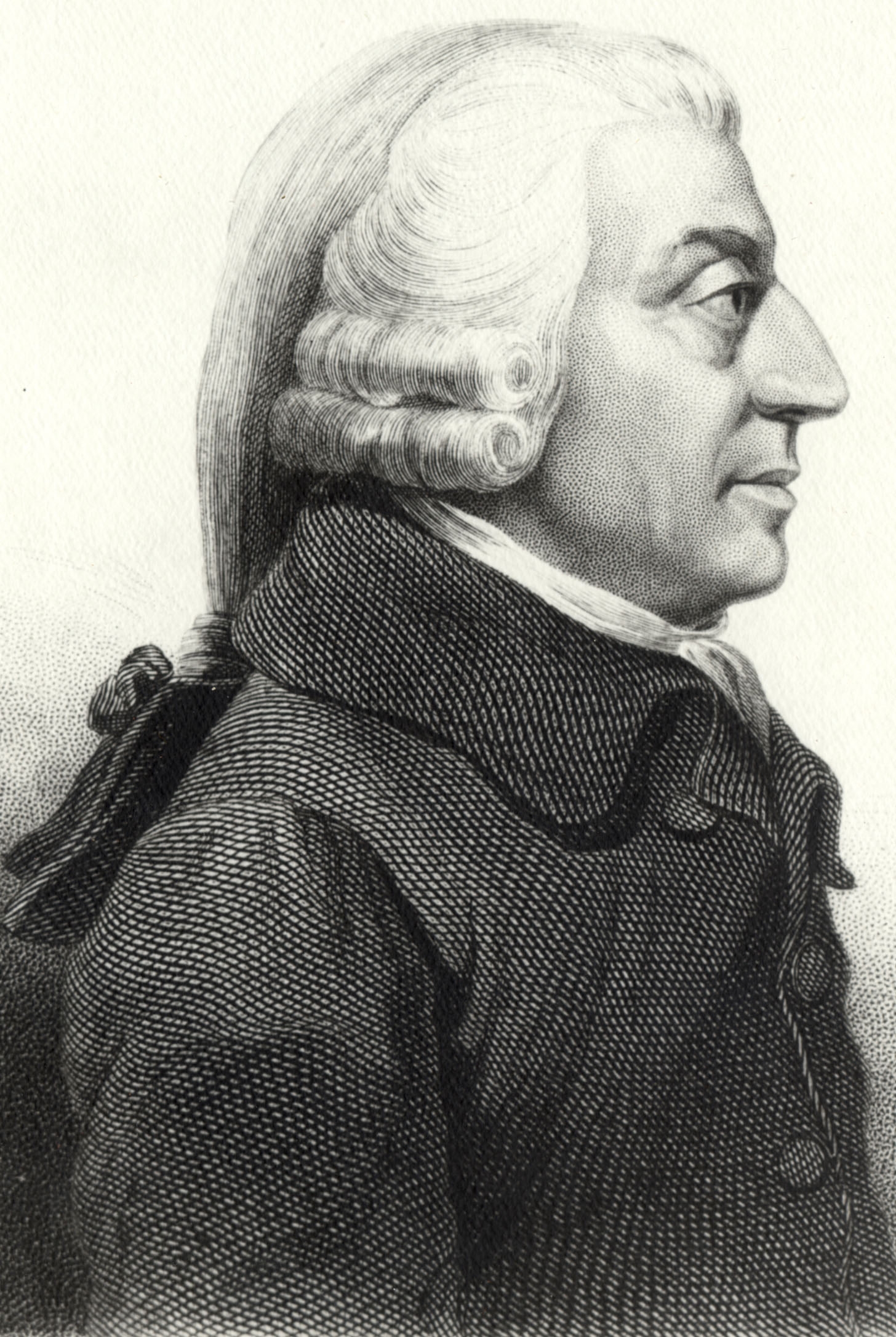
Adam Smith’s economy was a “Deist” economy. It was based on the understanding that an economy has natural laws. For Smith, the way to talk about economics was to talk about the political economy, and his famous book, The Wealth of Nations, is a book on political economy. Karl Marx, by the way, used the same analysis in his famous book, Capital.
The Wealth of Nations is a book filled mostly with descriptions of different types of land use, enterprises, and employment. It is a beautifully written book, but most certainly not captivating. Nevertheless, two things stand out. One is how Smith introduces his famous “invisible hand” to describe how individuals, pursuing their self-interest, almost secretly (without knowing) contribute to the social well-being of the whole. The invisible hand is Smith’s economic way of saying that left alone, an economy follows its own natural laws. Smith makes a lot out of how the state, when it interferes with the natural economy, makes a mess of things. When it comes to economic benefits for all, the best act of the state is to let the economy operate as nature intended.
The second interesting comment that Smith makes is how the economy is structured. He names three classes involved in the functions of the economy. These classes are, of course, the classes he perceived in eighteenth-century England. The first class is the renters: estate owners who rent their massive land holdings (think of Downton Abbey). The second is the merchants who own houses of production, like a carriage house where carriages are built. We would call this second class the capitalists (think of Henry Ford). The third class is the worker who is hired by the merchant to produce goods. We see in Smith the beginnings of labor as we know it today (think of workers on a factory floor).
Interesting points follow from Smith’s observations that should make us hesitate about classifying him as the original advocate for laissez-faire capitalism. The main one is that of the three classes Smith names (the renters, the merchants, and the workers), the merchant class (the capitalists) are the most untrustworthy. According to Smith, capitalists will lie, cheat, underpay, horde, and exploit. He is clear that the capitalist class needs to be governed by a set of rules. Even though he doesn’t think the state should interfere with trade, he is clear that the state needs to make sure the rules of the game are observed. So, yes, he does have a social conscience and a touch of socialism in his political economy analysis.
Another interesting point is that Smith is generally against tariffs, or what he called duties. He thought that duties caused inflation, unemployment, and high prices. He believed that the wealth of a nation was earned in its ability to trade on the common market, producing what it is good at producing and buying what it does not produce. Duties contradict the fundamentals of exchange because while they protect merchants, they create mercantile monopolies. In other words, they create plutocracies because there is an economic loss of competition that creates an opportunity for one company to control the domestic market.
Finally, when Smith said the state should stay out of public trade, he did not mean that the state should be invisible. He did have a role for the state, which is to ensure market thriving uplifted the poor. It has often been noted that in his writing when there is a conflict between the powerful and the poor, Smith sided with the poor every single time.2
Though personally a Deist, Smith lived in a Christian state, not a secular one, but his was a Christian state of charity, not of nationalism. Charity means that the state is concerned about poverty and should indeed act to curtail it. We do not know explicitly what guided Smith in this ethical attitude, but I’m willing to guess that one biblical passage played a role. “Whatever you have done for the least of these you have done also for me” (Matt 25:40).
Here is where theology comes in. The value of a religion is compassion. The theological imperative is justice. And whatever we think the state should or should not be, the measurement of a successful state is not money or power but the general level of well-being for all its citizens and resident aliens. Insofar as there is hunger there is, Smith thought, state failure. I think on this last point, Jesus would have agreed.
1. Milton and Rose Friedman, Free to Choose (New York: Harcourt Brace Jovanovich, 1979), 1–2.
2. Christopher Martin, “Adam Smith and the Poor: A Textual Analysis,” in Journal of Economic Behavior & Organization, Volume 184 (April 2021), 837–49.
Thumbnail Image: Vladimír Krupa 81, CC0, Public Domain via Wikimedia Commons
Get new scholarship, events, and blog posts delivered straight to your inbox.


Join the Conversation in the Westar Public Square
We’re updating how we engage with your thoughtful feedback! Blog post comments will no longer be hosted on our website. Instead, members can join the conversation in the Westar Public Square, where blog post links will be shared for deeper discussions.
Not a member yet? Join us to connect with a vibrant community exploring progressive religious scholarship! Become a Member Today