

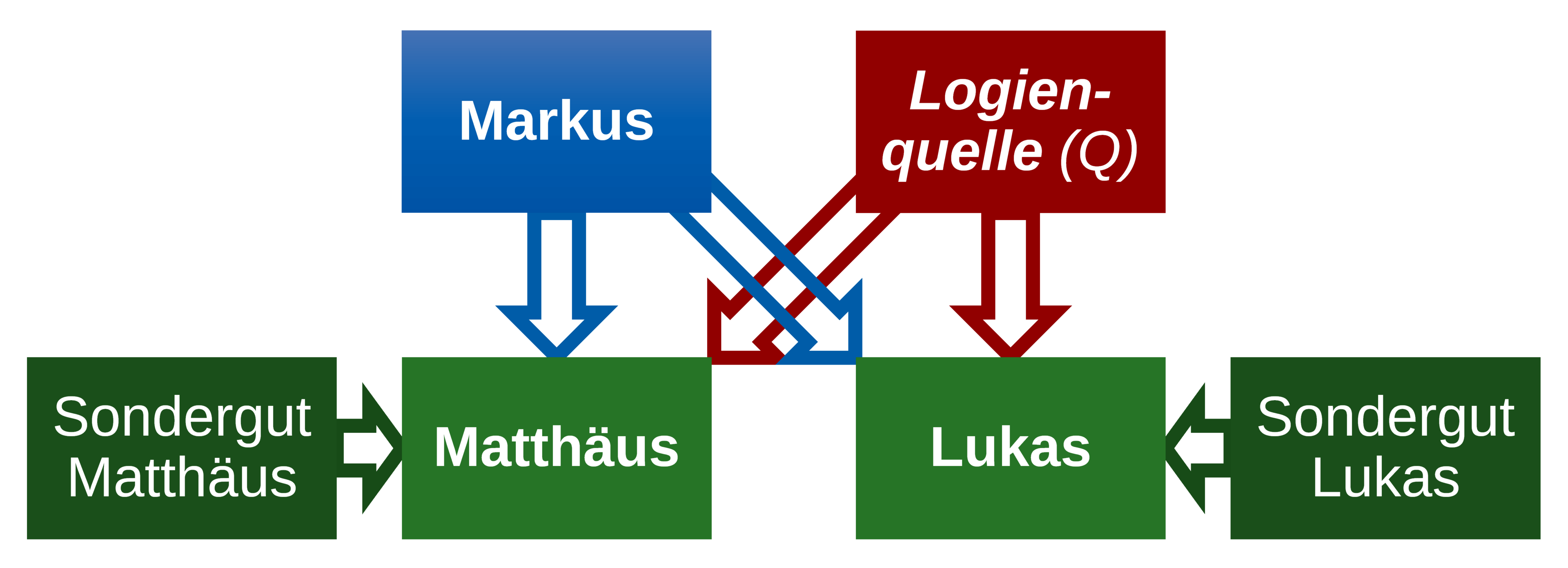
The Gospels of Matthew and Luke share a common source of Jesus sayings, which is called Q. It is usually understood that Q comes from the German word Quelle for source. It is a reference to the parallel sayings that are found in Matthew and Luke but missing from Mark. Ironically, the German scholars of the nineteenth century who discovered Q used the letter L to identify the source, L being for Logia or sayings. Today, however, Q is the common reference used.[1]
Matthew and Luke use the Q source in unique ways. Sometimes they use it verbatim, but more often they give it a twist to suit their narratives and their theologies. Scholars believe that Luke preserves Q more directly, and on this foundation, I used to believe that Matthew was more conservative than Luke. Over time, I changed my mind.
For example, I used to regard Matthew’s version of the Q saying on poverty as a sellout. In Q (Luke 6:20), the saying is direct, markarioi hoi ptōchoi (which is plural, and I translate as “happy are those in poverty”). Following the same line of translation, Matthew 5:3 has, “happy (markarioi) are those in poverty of the spirit.”
The Greek word markarios appears in Plato, particularly in the Meno dialogue (71a) where it is used comically. Socrates says to his interlocutor that “you must think I am fortunate” to know that virtue can be taught. Then, Socrates corrects this impression, saying that he does not know whether virtue can be taught because he doesn’t even know what virtue is! This is a very typical Socrates-like comment. Nevertheless, fortunate in this sentence translates makarios. We could also translate Socrates as saying, “You must think I’m lucky” (or happy or blessed).
It seems like Matthew takes the surprising Q aphorism that mixes poverty with joy and softens it as much as possible. Matthew’s Greek is makarioi ptōchoi tō pneumati, traditionally translated as “blessed are the poor in spirit.” So, in Matthew, you do not have to be poor actually; you just need to be humble–or so it seems.
For years, I felt that Matthew was a timid writer who chose not to challenge the wealthy of his age. Whereas the Q saying deconstructs the association of happiness with wealth, and whereas Q insists that “if you want to find joy, then stick your nose in poverty,” Matthew seems to say, “well, not ‘real’ poverty, just poverty in spirit.”
Gradually, after many conversations with Westar colleagues, I have changed my mind. Matthew is more radical than Luke, maybe even more radical than Q, but it is harder to hear this in translation. Matthew’s ptochoi tō pneumatic is not necessarily a reference to an abstract spiritual notion of poverty. The Greek can be rendered as a reference to those “of the (tō) impoverished spirit.” This makes a difference. We hear spirit as a reference to something ethereal, some nonphysical place or quality. Spirit is vague in English. In Matthew, the attempt is to render in Greek the Jewish sense of poverty before God. It might be said that Matthew does a pretty decent job, given the options, even though something is lost in translation.
If we think of the ancient Greek culture, we can sense what Matthew wants to invoke. In Greek, the “spirit” is breath, and in philosophy particularly it is the energy of potential. The spirit motivates the mind (nous) and creates the force of the body. In both Plato and Aristotle, the spirit is directional, motivating, and properly aimed at virtue (and an improper aim of the spirit results in sin). The Apostle Paul may have shared in the same translational exercise when he uses the Greek idea of spirit to say that being in the body of Christ (or the anointed) is to share a spiritual direction (qualities and values) distinct from the Roman imperial spirit (which, of course, is a spirit without values, a spirit of sin).
When Matthew talks about “the poor of the spirit,” the reference is close to what in our terms would be those without energy, without breath, and without voice (for voice expresses spirit/breath). Matthew is talking about the de-energized, the isolated, and the abandoned whose spirit cannot move toward social standing because it has been robbed of potential. Remember, in Greek philosophy, no potential means no spirit. We might even say that the impoverished people Matthew is thinking about are those the empire has robbed both of money and of hope. The poor in the spirit are the disempowered ones who have no exit from their desperation or their hunger, but the shock is that the depth of happiness is found here.
After my enlightenment in the Jesus Seminar, I started translating Matt. 5:3 as, “Happy are the breathless ones, for they breathe the spirit of God.” This places greater attention on poverty as suffocation and on spirituality as a breath that resists the suffocation of poverty. It is as if Matthew is striking a double underline of the Q saying, not bailing out on it. And it is certain here that Mattthew, not Luke, understands far more what poverty really means.
[1] Johannes Weiss (1863–1914) is credited with originating the designation Q, but it is unclear whether he meant Quelle or was just employing an arbitrary letter.
Thumbnail image: Chris Light, CC BY-SA 4.0 <https://creativecommons.org/licenses/by-sa/4.0>, via Wikimedia Commons
Get new scholarship, events, and blog posts delivered straight to your inbox.


Join the Conversation in the Westar Public Square
We’re updating how we engage with your thoughtful feedback! Blog post comments will no longer be hosted on our website. Instead, members can join the conversation in the Westar Public Square, where blog post links will be shared for deeper discussions.
Not a member yet? Join us to connect with a vibrant community exploring progressive religious scholarship! Become a Member Today