

After Paul’s so-called Damascus experience, or as he calls it his revelation or insight (apocalysis, Galatians 1:12), he saw himself fundamentally as a slave of Jesus Anointed. Paul a slave is part and parcel of his call to be an envoy or apostle. In the address to the letter to the Romans, Paul names himself as:
(From) Paul,
a slave of (enslaved by) Anointed Jesus
called to be an envoy (apostle)
designated for g-d’s world transforming news.
Since the final two descriptors mean the same thing, we should assume that the first one is closely related.
This is the most elaborate address among Paul’s letters. Philippians also has the descriptor slave—“(from) Paul and Timothy, slaves of Anointed Jesus” (1:1). In the earliest letter, 1 Thessalonians, the writers are simply, “(From) Paul and Silvanus and Timothy,” with no descriptor. Galatians and 1 and 2 Corinthians employ the single descriptor envoy.
As these addresses indicate, Paul closely identifies his apostleship with being enslaved. In Galatians, where his apostleship is under threat, he retorts, “If I were still looking for human approval, I would not be the Anointed’s slave” (Galatians 1:10). In a similar response to an attack on his apostleship in 2 Corinthians, he claims “For we do not proclaim ourselves; we proclaim Jesus Christ as master and ourselves as your slaves for Jesus’s sake” (4:5 NRSVUE). This shifts the master from g-d or Jesus Anointed to the audience, the community in Corinth.
Since Paul understands both Jesus and g-d as masters (kurioi), the master/slave logic is complete. A slave is one who has no control of their body or will. The master has total control. After his call, Paul sees himself as totally controlled by g-d or Jesus Anointed. The call is so overpowering, he has no choice.
Even though he applies the title slave to himself, he seldom applies it to those who have been baptized. For them, the category of slavery is inappropriate. The Greek phrase ἐν Χριστῷ (en christō) “in the Anointed” encapsulates his understanding of one of the two possible states of being. “In flesh” is the state before faith and “in the Anointed” is the state after faith. This is code language, starkly abbreviated.
In Galatians 3:26–28 he expands it. “Through the kind of confidence (pistis) exemplified by God’s Anointed,” he concludes, “you are all now God’s adult offspring” (Galatians 3:26).
As a result of a faithfulness like Jesus’ or baptism, which for Paul are the same thing, they are “in the Anointed,” or as the Scholars Version (SV) translation explains, they have “been baptized into solidarity with God’s Anointed.” What is it like to be baptized in Christ, or baptized into solidarity with God’s Anointed? Paul draws on the metaphor of clothing. “You have clothed yourself with the Anointed” (my translation). The SV expands this metaphor as “become invested with the status of God’s Anointed.”
Since everyone now has the status of the Anointed, Paul draws the momentous conclusion, “You are no longer Jew or Greek, no longer slave or freeborn, no longer ‘male and female’” (3:28). This voids every important social distinction in the ancient world. But for Paul this is true only within the community of the Anointed, not in the Roman Empire. These very distinctions characterize the empire.
Because these distinctions characterize the Roman Empire, Paul’s rule for all his communities is “each of you should continue to live the life the master has apportioned to you as you were when g-d called you” (1 Corinthians 7:17). Because Paul thought that the end was imminent, he counseled not to change one’s situation. But “if you are able to become a freedman, take advantage of it” (7:21). From this he draws his generalized conclusion: “The point is this: anyone who was a slave when called to be one of the master’s people is one of the master's freedmen, and likewise anyone who was free when called is the Anointed’s slave” (7:22). This is the only place where he refers to others as “the Anointed’s slave.” The logic seems to be, since there really is “no longer slave or freeborn,” it makes no difference if you are free or slave. This is clearly written from a free person’s point of view. I can imagine the enslaved in his audience saying, “Easy for you to say!”
For Paul those in the Anointed, in the community, are free; those in the empire are enslaved. He makes no effort to change the empire. It cannot change and is doomed to pass away. The promise of freedom is in the community and in the future. Paul engages in no critical analysis of slavery. Those in the Anointed are free, they are also still enslaved, only to a different master. “Thank God that although you were slaves of the power of corruption [sin] you have become obedient from the heart to the pattern of teaching with which you were entrusted, once you were liberated from that corrupting power [sin], you became slaves in the service of what is right” (Roman 6:17–18). Paul is still caught in the master/slave model and has not thought his way out of it. He admits, “I am speaking in common, ordinary terms to accommodate your limited powers of comprehension” (Roman 6:19). That is, he’s struggling. The problem is the model master/slave. Paul does not question its fundamental validity because that would challenge his primary understanding of g-d as master and all humans as g-d’s slaves.
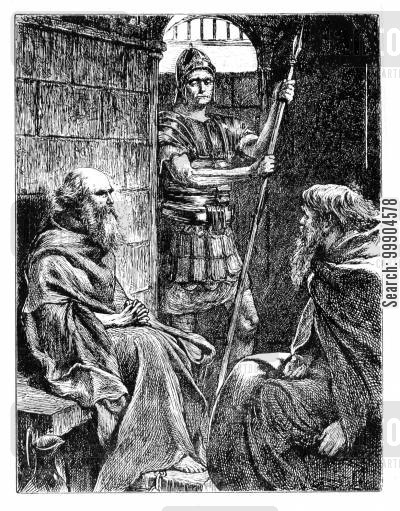
Paul has got hold of the problem. He understands that (1) in the Anointed there are no distinctions; (2) freedom characterizes this state, not slavery. He does make one major effort in 1 Corinthians 12 to envision a new politics for the community in his working out of the body metaphor as applied to the community of the Anointed. Paul begins with a physical metaphor. ”Just as the body has many parts and all of the parts, even though there are many of them, are still parts of one body, so is the body of the Anointed” (1 Corinthians 12:12). Paul employs the physical body as a metaphor for the Anointed’s body. His basic argument is that the body has many parts but is still one body. The same is true for the community “For we were all baptized by the same power of God into one body, whether we were Jews or Greeks, slaves or free, and we were all invited to imbibe the same divine power”(12:13).
The body is a common metaphor in Greek political thought, where it is used to support unity, which Paul does as well, and hierarchy, which Paul does not. In common Hellenistic usage, some parts of the body are more important and rule over other parts, for example, the mind rules over inferior parts. This of course reflects and justifies the master/slave hierarchy. Paul denies this. The body has many parts, but there is only one body. All the parts are necessary. “It's just not possible for the eye to say to the hand, ‘I have no need of you;’ or for the head to say to the feet, ‘I have no use for you’” (12:21). The body needs all of its parts. None is hierarchically superior; all are part of the body. “If one part is in pain, all parts suffer; if one part is honored, all parts celebrate” (12:26).
Notice what is missing. The Anointed is not a part, the head as in Colossians 1:18, but is the body itself. “All of you together are the body of the Anointed and individually you are members of it” (12:27). At this point, Paul breaks free of his metaphor. He is on the verge of critical thinking. He has begun to conceive a new politics, a way of living together, that escapes the master/slave model of the ancient world. He has seen the other side, but how far did he get?
In Paul’s short letter to Philemon, we have a suggestion of how far he got. He asks Philemon to welcome back his runaway slave Onesimus, implying that Philemon should set Onesimus free and charge it to Paul’s account. Yet he does not directly face the master/slave problem. If “there is no longer slave nor free” in the community, but all are part of the body of the Anointed, why is Paul worried? Because Philemon is not only the head of the community in his house (a house church) but also a slave master. So, what does it mean to be free? Is it only metaphorical? Spiritual? A slogan? Paul fails to address this problem.
Paul faced a real conundrum. Those in Christ are free, freedom is the chief characteristic of g-d’s life. But Paul still envisions g-d and Jesus as masters. He is trying to think himself into a new worldview but is trapped in the Roman Empire, a world of masters and slaves. While he can imagine a life without slaves, he cannot imagine a life without a master. Is that really a free life? Paul needs a new image of g-d.
The Enlightenment marks the moment that breaking free of the master/slave model’s domination of political reality began. As Jefferson wrote, “We hold these truths to be self-evident, that all men are created equal.” Jefferson struggled and failed with this and we are struggling with it still. Equality and freedom are not based on grace or faith, a theological principle, but on the evident worth of each human being. This insight of the Enlightenment cracks the problem open and leads to a new politics, democracy, not unlike Paul’s view of the Anointed’s body. Paul took the first step. The Enlightenment thinkers took the next step, and the American Constitution introduced the most important freedom enhancing political experiment in humanity’s history.
Are we living through its destruction?
A new image of g-d remains beyond the horizon.
We are still wrestling to free ourselves of masters enslaving others.
How long until “there is no longer slave or free”?
Get new scholarship, events, and blog posts delivered straight to your inbox.


Join the Conversation in the Westar Public Square
We’re updating how we engage with your thoughtful feedback! Blog post comments will no longer be hosted on our website. Instead, members can join the conversation in the Westar Public Square, where blog post links will be shared for deeper discussions.
Not a member yet? Join us to connect with a vibrant community exploring progressive religious scholarship! Become a Member Today