

Then they returned home, but Jesus went to the Mount of Olives. Early in the morning he showed up again in the temple area and everybody gathered around him. He sat down and began to teach them.
The scholars and the Pharisees bring him a woman who was caught committing adultery. They make her stand there in front of everybody, and they address him, “Teacher, this woman was caught in the act of adultery. In the Law Moses commanded us to stone women like this. What do you say?” (They said this to trap him, so they would have something to accuse him of.)
Jesus stooped down and began drawing on the ground with his finger. When they insisted on an answer, he stood up and replied, “Whoever is sinless in this crowd should go ahead and throw the first stone at her.” Once again he squatted down and continued writing on the ground.
His audience began to drift away, one by one—until Jesus was the only one left, with the woman there in front of him.
Jesus stood up and said to her, “Woman, where is everybody? Hasn’t anyone condemned you?”
She replied, “No one, sir.” “
I don’t condemn you either,” Jesus said. “You’re free to go; but from now on, no more sinning.”[1]
The story of the Woman Caught in Adultery is one of the best-known stories in the New Testament but ironically doesn’t belong in the New Testament. The story is missing from all the major manuscript evidence.
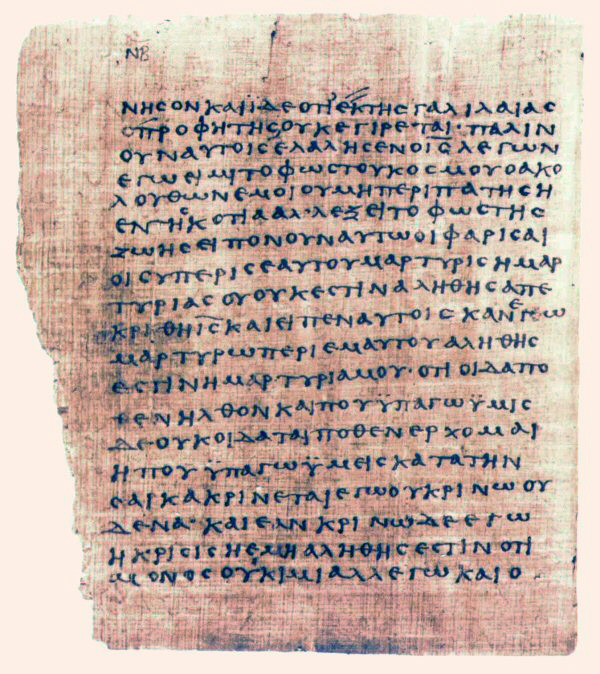
Codex Alexandrinus (fifth century) is the third major uncial[2] manuscript, and it is defective in this part of the Gospel of John where the story traditionally appears (John 7:53–8:11). However, a careful measurement of the defective section of this manuscript indicates that it is not large enough to have contained the story.
In the East, the story is absent from the earliest translations into Syriac, Coptic, and Armenian. No Greek church father refers to the story before the twelfth century. In the West, many early Latin manuscripts are also missing the passage.
The style and vocabulary also tell against the story. Its vocabulary differs from the rest of the Fourth Gospel. Finally, the story interrupts the natural flow from 7:52 to 8:12.
In some manuscripts the story is inserted after John 7:52, or 7:3, or after 21:25, and in some manuscripts it is after Luke 21:38. It is, indeed, a floating logion.
The weight of the manuscript and internal evidence against the inclusion of the story in the Gospel of John is overwhelming, even conclusive. It does not belong in the Fourth Gospel.
How then did the story get into the New Testament? The story was known in the East at an early date. Papias (about 125 ce) may have known it as part of the Gospel of the Hebrews, according to Eusebius in his Church History (fourth century, 3.39.17). The Didascalia Apostolorum (Teaching of the Apostles, third or fourth century) also knew it. In the West, it appeared in a few Old Latin manuscripts, and both Ambrose (about 340–97) and Augustine (354–430) understood it as part of the Gospel of John. Jerome included it in his translation of the Bible into Latin (about 342–45), known as the Vulgate, which became the official translation in the West. When the great humanist scholar Desiderius Erasmus published the first printed edition of the Greek New Testament in 1516, he based his Greek text on late Byzantine Greek manuscripts, the best available to him. These late Greek manuscripts contained the story of the Woman Caught in Adultery. Erasmus’ printed text became Textus Receptus (“The Received Text”), which in turn became the basis for the first modern translations into German (Martin Luther, 1522) and English (King James Version, 1611). These hugely influential translations cemented the Woman Caught in Adultery in the narrative of the Fourth Gospel at 7:53–8:11. Modern translations, on the other hand, have been trying to remove it or bracket it as not part of the Fourth Gospel.
Despite the fact that the story of the Woman Caught in Adultery is not part of the New Testament, it appears on the fifth Sunday of Lent in the lectionaries of the various denominations—Catholic, Episcopal, Lutheran—but not the Revised Common Lectionary.
The story has been valued because of Jesus’ mercy toward the woman, but the emphasis on mercy hides a problematic aspect. It takes two people to commit adultery. Only the woman is accused and brought forward. She alone is treated as an object lesson in a transactional fashion.
[1] Robert J. Miller, ed., The Complete Gospels (Santa Rosa: Polebridge Press), 2010, 460–61.
[2] An uncial manuscript is a manuscript written entirely in capital letters. This was common practice in Greek and Latin right up until the eighth century.
Get new scholarship, events, and blog posts delivered straight to your inbox.


Join the Conversation in the Westar Public Square
We’re updating how we engage with your thoughtful feedback! Blog post comments will no longer be hosted on our website. Instead, members can join the conversation in the Westar Public Square, where blog post links will be shared for deeper discussions.
Not a member yet? Join us to connect with a vibrant community exploring progressive religious scholarship! Become a Member Today