

On Thursday morning, November 5, at the Bob Scott Retirement Village in New Zealand, distinguished scholar and longtime Westar friend Sir Lloyd Geering died. He was 108 years old.
Lloyd Geering was a foundational figure in both biblical and theological studies, challenging, through his publications, the very reasoning and aim of traditional Christianity. Throughout his lengthy career as a consummate learner and remarkable professor, he placed under a magnifying glass questions about the future of religion in light of modern science. Like a Socrates figure, he acted as a gadfly pestering the church to confront the modern world. His many publications are a testament to his penetrating and persistent insight.
Lloyd will be remembered as a kind and generous person, a provocative speaker, and a great scholar committed to hope in our collective human future. Westar joins innumerable others in expressing condolences to Lloyd's family and his many friends.
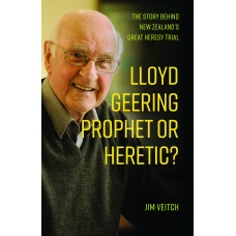
In a tribute to his legacy and in honor of his memory, Westar scholar Brandon Scott reviews James Veitch’s 2025 book, Lloyd Geering: Prophet or Heretic? In Veitch’s engaging study, all the great qualities of Lloyd Geering stand out, including, most particularly, his insistence that the church needs to confront and come to terms with modern biblical criticism.
Various Christian churches have resisted, raged, and confronted coming to terms with modern biblical studies. Any gain has been grudging and hard won. Jim Veitch’s Lloyd Geering: Prophet or Heretic? The Story behind New Zealand’s Great Heresy Trial (Bayswater, Australia: Coventry Press, 2025) is an engaging study of one moment in that ongoing battle: Geering’s 1967 heresy trial in New Zealand.
Although Aotearoa, New Zealand, is a small and at times remote country, with its own special history, yet in microcosm it offers a picture of a universal situation.
All politics are local, and so too are church situations. The church (universal) is an abstraction. What really exists are denominations and churches. And yet, there is a universal situation based on common traditions and histories. Lloyd Geering’s heresy trial was one of the most important events in New Zealand religious history and caught the attention of the whole nation.
As an undergraduate at the University of Otago, New Zealand, Geering majored in mathematics and physics, staying on for masters. This scientific training influenced his intellectual outlook for the rest of his life. He received his theological training at Knox Theological Hall at the same university and was ordained a Presbyterian minister. He then pursued a PhD in Old Testament, again at the University of Otago. Although his education was at one university, that university was not provincial but up to date with the latest critical scholarship. Geering then took up a position as professor of the Old Testament at Knox Theological Hall in 1960, where students for the Presbyterian ministry were trained. He eventually became principal of Knox Theological Hall in 1963. This was an important position in Presbyterian circles in New Zealand.
In 1966 in a series of articles in Outlook, the Presbyterian Church’s magazine, Geering suggested that Jesus had not risen physically from the dead; to understand the resurrection in this way was to misread the gospels. He also argued that humans do not have an immortal soul. Finally, he maintained that to read the Bible literally was wrong; it should be read in its historical context.
He was charged by a lay member and a minister with doctrinal error and “disturbing the peace and unity of the church.” The Presbyterian Church’s General Assembly debated the charges. The interest was so high that the proceedings were televised, fostering much discussion within and without the church. After extensive debate, the Assembly declared that no doctrinal error had been proven. This is too simple a summary. Veitch has the details. The Assembly took no action against Geering.
But the televised trial was not the end. The next year, concerns about Geering were raised again in the General Assembly. Here the story becomes almost too labyrinthine to follow, although Veitch does his best to untangle the threads. Geering acted first. He accepted a position at Victoria University of Wellington, resigned from his position with the Knox Theological Hall, but remained a minister of the Presbyterian Church of New Zealand. He remained an important public intellectual in New Zealand and a force in the Presbyterian Church of New Zealand.
As with the Charles Briggs case in the United States, following Geering’s trial, the Presbyterians in New Zealand began to split into literalist and progressive camps. The breech has not been healed.
Geering’s story is of interest not only to those in New Zealand, but to all those interested in the ongoing efforts of Christians to come to terms with modern ways of thinking. There is no evidence that the conflict is abating. Reactionary Christianity, both in its fundamentalist and Catholic forms, is at the heart of the MAGA movement. Geering’s story indicates that a viable form of Christianity can emerge from an engagement with modern critical thought. He remained a Presbyterian minister in good standing to the end of his life.
The real tension is between the future and the past. Where does the truth lie? Is theology settled or yet to be discovered? Do we stand in a tradition, frozen in place? Such a place is ahistorical. The church and churches, Christianity and Christianities have always been changing, shifting, evolving, renewing themselves. History demonstrates it over and over again, despite dogma’s claim to be unchanging. Nothing is unchanging. Fundamentalism, conservatism, and traditionalism are modern positions, reactionary movements against modern scientific ways of thinking. They are not ancient positions as they claim. The only way to live in the past is to destroy the future.
Veitch’s book is important because it preserves the details for future generations to examine. Veitch has scrutinized this episode in granular detail like no previous similar episode has been examined. He knows the principals, has their archives or access to them. He understands the context in Aotearoa, New Zealand, in the Presbyterian Church in Aotearoa, New Zealand. He lays out the theological ferment of the 1960s. He makes available all the details. He tells the story in a thorough way in exhaustive detail. He has a point of view, forcibly presented. But, and this is an important “but,” he has gathered and presented the evidence in such a way that future generations of scholars will be able to re-examine the evidence in their own ways. A marvelous accomplishment!
As to the title, Heretic or Prophet?, is there a difference?
Get new scholarship, events, and blog posts delivered straight to your inbox.


Join the Conversation in the Westar Public Square
We’re updating how we engage with your thoughtful feedback! Blog post comments will no longer be hosted on our website. Instead, members can join the conversation in the Westar Public Square, where blog post links will be shared for deeper discussions.
Not a member yet? Join us to connect with a vibrant community exploring progressive religious scholarship! Become a Member Today